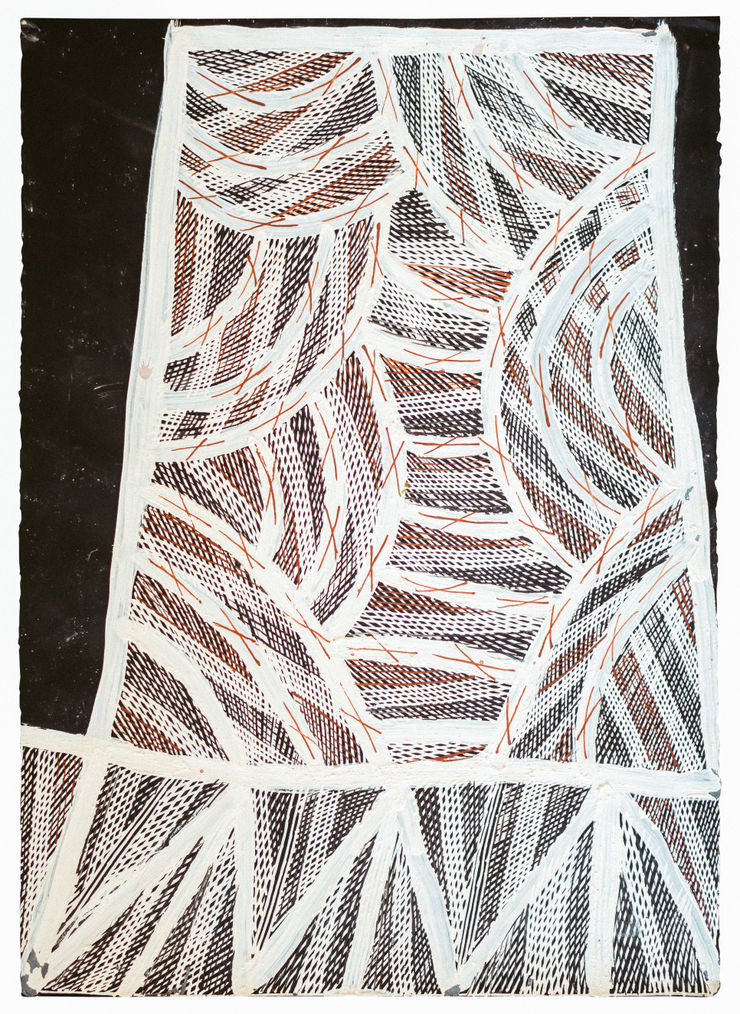
"Our art and culture are very closely tied together, you can’t separate them. But as a contemporary artist I can take inspiration from ceremonial art and take it in a new direction. I’m not taking ceremonial objects out of context so it doesn’t change the cultural significance, I’m creating something new from what I’ve learned and bringing it to a whole new context."
– Luke Djalgarrarra, 2026.
LONDON, 6 May, 2026 − JGM Gallery presents Old Way, New Road, an exhibition of works by Indigenous contemporary artists focused on the use of natural mediums, including ochre pigments, bark and wood.
Old Way, New Road explores how the exhibiting artists have adapted natural mediums from their use in ceremonial and initiatory contexts to contemporary art. Bringing together painters and sculptors from Arnhem Land, Melville Island, the Kimberley and Cape York, this exhibition compares the different uses of natural mediums across various cultural and individual artistic practices.
Ground and rock ochre, feathers, ashes, wooden carvings and plant fibres have long been used by First Nations Australians as devices in ceremonial and initiatory contexts. In Arnhem Land, hollow log coffins are used by the Yolngu in burial rites. In Cape York, sculpture carved from yuk thanchal (milk wood) depicting totemic figures are used by the Wik peoples as aids in ritual ceremonies. Across Australia, body painting and adornment for ceremony using natural materials is a common practice among many First Nations groups. Old Way, New Road examines how these practices have been maintained and developed through contemporary art.
In the early twentieth century, a number of anthropologists were commissioning ochre pigment paintings on portable bark supports from Indigenous artists in the northernmost region of the Northern Territory for study collections (Caruana, 2019). Later on in the 1970s, at a similar time to the beginnings of the Western Desert painting movement in the community of Papunya (1971-72), interest in bark painting from the commercial art market surged. In both the Western Desert and Arnhem Land, transposing “revelatory” cultural knowledge onto portable mediums for non-Indigenous viewership presented Indigenous artists with new challenges and possibilities for their aesthetics and narrative techniques (Myers, 2013). Nevertheless, in both synthetic and natural mediums, artists’ work remained imbued with the stories and knowledge which had been passed down to them verbally over tens of millennia. Now, the vibrant colours of acrylic paints, motif-driven compositions and dotting have become synonymous with Indigenous contemporary art. However, works made using natural mediums – particularly bark painting and wooden sculpture – are perceived by many through a more conservative lens, perhaps regarding their likeness to ritual objects.
The exhibiting artists of Old Way, New Road often use forms or motifs that retain significance in Indigenous cultures to convey sensory, place- and movement-based experiences in their work. In Phyllis Thomas’ (Gija) Gemerre (2008), for example, the artist makes sweeping, drybrush marks of blue ochre paint horizontally across a rich, black backdrop. These parallel lines are more gestural than precise, intonated with smooth swoops and curves. The dryness of the blue pigment picks out the grain of the black paint beneath, which emphasises the layering of the work’s composition. Thomas’ scraping marks and her layering of pigments relates to the painting’s subject. Gemerre depicts the scarification which Gija people received for protection and as a marker of identity. These initiation scars were cut across Gija peoples’ bodies, including Thomas’ own chest, and filled with ashes to accentuate the incision while it healed. The manner in which Thomas represents this subject matter suggests a body in motion and the texture of ageing scars, sitting raised against unmarked skin. Thomas paints subjects inspired by Gija ceremonial activity, using elements of these cultural events and practices to inform her work’s minimalist aesthetic. Gemerre’s sense of immediacy and movement brings the viewer closer to Thomas’ experience of Gija cultural practices and their significance.
A preference for acrylic painting is perhaps indicative of the distancing of Indigenous art from anthropological classification and its re-evaluation as contemporary art. Works made using natural mediums bear associations with the contexts of ceremony where the practice of using these mediums originates. However, works using synthetic mediums bear closer resemblance to the art of international modernism, such as Abstract Expressionism. Old Way, New Road addresses the binary approach to these mediums, conveying that innovation can still occur within the perpetuation of a tradition (Perkins, 2007). Using natural mediums to make art is a contemporary practice and remains relevant to how First Nations artists are shaping their visual cultures and identities.
Exhibiting artists: Arthur John Cowell, Loretta Davis, Luke Djalgarrarra, Dora Griffiths, Peggy Griffiths, Malaluba Gumana, Manini Gumana, Kittey Malarvie, Leigh Namponan, Kenan Namunjdja, Pamela Namunjdja, Alison Puruntatameri, Carol Puruntatameri, Christine Puruntatameri, Lucinda Puruntatameri, Mary Umagarri Teresa Taylor, Phyllis Thomas, Delores Tipuamantumirri, Keith Wikmunea, Mulkun Wirrpanda, Apphia Wurrkidj and Russell Ngadiyali Wanapuyngu.
-
 Delores TipuamantumirriBanapa, 2021Ochre on canvas180cm x 120cm
 -
Peggy GriffithsJinamoom, 2012Natural ochre on paper75cm x 89cm
-
Carol PuruntatameriYipali and Purrukupali III, 2024Ochre on canvas180cm x 120cm
-
Phyllis ThomasGemerre, 2008Natural ochre on board100cm x 80cm
-
Kittey MalarvieLuga, 2016Natural ochre on paper75cm x 89cm (framed)
-
Alison PuruntatameriWinga V (Tidal Movement / Waves), 2024Ochre on linen120cm x 80cm
-
Russell Ngadiyali WanapuynguNgilipitji, 2025Natural ochre on paper56cm x 38cm
-
Mulkun WirrpandaNadi ga Gundirr (Meat Ants And Termites) IV, 2020Earth pigment on paper89.6cm x 70cm (framed)
-
Mary Umagarri Teresa TaylorAru (Rocks)Natural ochre on paper75cm x 89cm
-
Christine PuruntatameriPwonga IINatural ochre on Arches paper85cm x 70cm (framed)
-
Malaluba GumanaDhatam, 2013'Larrakitj' (hollow log) and ochre pigments, includes stand166cm
-
Apphia WurrkidjMimih Spirit, 2024Carved wooden sculpture, includes stand198cm x 4cm x 3cm